
Brain & Body Bootcamp Week 1

Body-Brain Foundation - The Hardware
Before we work with thoughts, emotions, relationships, or purpose, we begin with the body, the hardware. The reason is simple and well-supported by neuroscience: the brain adapts in response to what the body repeatedly does.
Week 1 establishes the WHAT of brain health— physical inputs that prep the brain for cognitive resilience and neuroplasticity.
THE PHYSICAL DIMENSION GUIDEPOSTS
Throughout Week 1, the following guideposts anchor our attention and practice: • Breath mechanics influence efficiency and physical effort • Posture shapes respiratory mechanics and oxygen delivery to the brain • Movement/Flow drives circulation that supports attention, memory and mastery • Integrated training (cardio, strength, and mobility) aids brain adaptation
Together, these guideposts highlight a central principle of brain health: How we move matters as much as how much we move.

WEEK 1 LEARNING OBJECTIVES: HIDING IN PLAIN SIGHT
Upon completion of Week 1, you will be able to explain how:
• Diaphramatic/Nasal Breath relaxes our body and maximizes circulation
• Posture and the inner core enable power, stability/balance, and strength
• Repetition enhances cognitive capacity
As participants move through the Physical Dimension, a common pattern often becomes visible—the gap between what we believe we do and what we actually practice consistently.
Many people assume they breathe efficiently, maintain functional posture, or move in ways that support brain health. When these habits are observed more closely, subtle and not so subtle inconsistencies often appear.
These patterns are not problems to fix immediately. They are signals—useful information that helps guide intentional change. Week 1 is designed to surface what may be hiding in plain sight so that our future practice becomes mindful rather than reactive or rote.
WHY VISUALIZING BRAIN CHANGE MATTERS
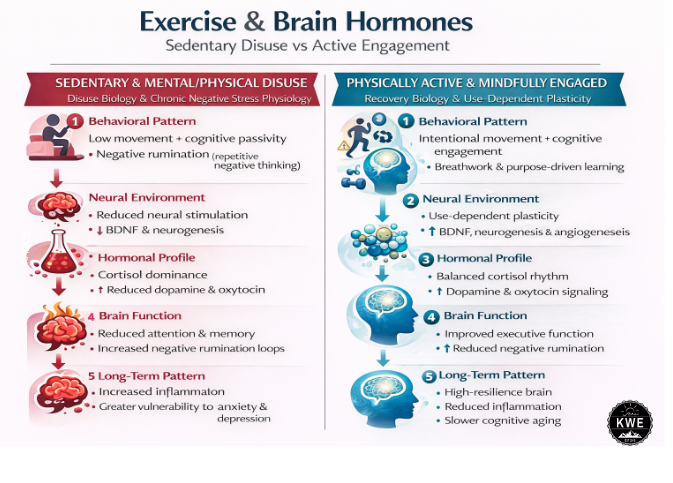
Understanding brain health becomes far more tangible when the biology can be visualized.
Seeing how intentional movement combined with learning increases brain-derived neurotrophic factor (BDNF)—and how this supports neurogenesis, synaptogenesis, and angiogenesis—clarifies why this approach differs from many conventional fitness or wellness programs.
The pdf of all Week 1 images, is available below, or you can watch our Week 1 Video Overview.
Movement is no longer rote physical effort. It becomes biological instruction for brain regeneration. See details below!
THE ASSESSMENT & THE PLAN
The Physical Dimension Assessment serves as both a mirror and a compass.
As a mirror, it reflects current physical habits honestly, often revealing gaps between intention and daily practice.
As a compass, it helps guide mindful planning for the next phase of the program.
The assessment is not about performance or perfection. It is about clarity—seeing where attention and intention will be most effective moving forward.
See below for easy access:
The plan worksheet below provides an easy to follow format to prioritize and plan specific actions to address the issues identified in the assessment.
WEEK 1 SLIDES ARE AVAIALABLE BELOW:
FROM WHAT TO WHY: PREPARING FOR WEEK 2
With greater physical awareness in place, participants begin examining mindfulness, learning, and cognitive flexibility, based on what they learn from the session and the Week 1 Assessment.
Week 2 builds directly on this foundation by exploring the Mental and Intellectual Dimension—the WHY.
When the body provides a stable foundation, the work of the mind - our software becomes clearer and more effective.
MOVING FORWARD
As you move forward:
• Complete the Physical Dimension Assessment & Worksheet
• Notice where habits align with intention—and where they do not
• Carry this awareness into the Mental Dimension
Meaningful change often begins not by doing more, but seeing more clearly.


