
Brain & Body Bootcamp Week 2

Updated: Feb 27
The Mental Dimension
Training the Brain’s Software for Focus, Calm, and Recovery
Week 2 of the Brain & Body Boot Camp focuses on the Mental / Intellectual Dimension—the brain’s software.
If Week 1 strengthened the hardware (breath, posture, movement, and circulation), Week 2 explains how and why those physical inputs change the brain, and how mental skills determine whether the nervous system escalates into fight, flight, or freeze—or shifts toward regulation, recovery, and flow.
Week 2 is guided by three learning objectives:
LEARNING OBJECTIVE 1: THE LINK BETWEEN BALANCE & EXECUTIVE FUNCTION
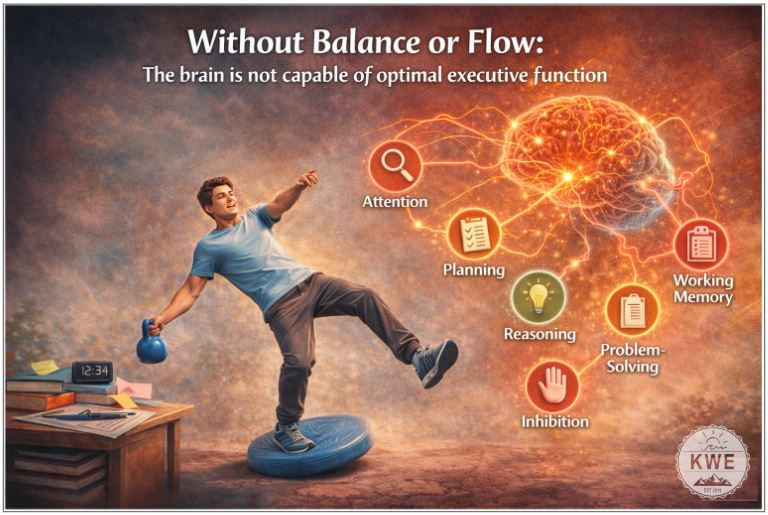
Executive function is not one task but rather a collection of higher-level brain processes that allow us to sustain attention, plan and organize behavior, reason and problem-solve, inhibit impulsive reactions, and hold and manipulate information (working memory).
Executive function acts as the brain’s command center, coordinating thought, behavior, and stress responses. When we are in physical and mental balance our executive function is strong. When our executive function is strong, our:
• Attention is steadier • Learning is retained • Stress is appraised rather than amplified • Reactions slow down before emotions escalate

Without physical and mental balance, the brain is not capable of optimal function....
LEARNING OBJECTIVE 2: APPLY MINDFULNESS AND MEDITATION FOR OPTIMAL BALANCE IN LIFE
A key focus in Week 2 is understanding the difference—and relationship—between mindfulness and meditation, and how we can use both to maximize our balance and flow through life, not just at the gym.
Mindfulness is a quality of awareness. It can be practiced anywhere, at any time, by noticing thoughts, sensations, and reactions without judgment.
Meditation is a structured practice. It is typically done in a dedicated time and space to intentionally train attention and stabilize the nervous system.
The two feed each other: meditation trains mindfulness, and mindfulness strengthens meditation. Together, mindfulness and meditation help:
• Reduce perceived stress
• Quiet the fight-or-flight response
• Improve mood and mental health
• Enhance executive functioning

LEARNING OBJECTIVE 3: PERFORM PHYSICAL ACTIVITIES THAT SUPPORT REST AND RECOVERY
Week 2 does not move away from the body—it refines how the body is used, with focused mindful awareness of our thoughts and feelings.
Physical practices this week emphasize balance, mobility, and dual-task coordination to challenge attention without overwhelm. These movements are designed to minimize excessive arousal and support the nervous system’s shift toward rest, repair, and flow.
By pairing movement with mindfulness, participants learn how to return toward optimal arousal rather than overtraining and or professional exhaustion.

THE ROLE OF THE WEEK 2 PRE-ASSESSMENT
The Mental / Intellectual Dimension Pre-Assessment is introduced as an awareness tool, not a test. It helps participants observe thinking patterns, notice attention and distraction, and identify how stress is mentally processed and distorted by perssimism.

The assessment serves as both a mirror for current habits and a compass for intentional planning, especially for reframing pessimism.
PREPARING FOR WEEK 3
By strengthening executive function and training attention, mindfulness, and learning, Week 2 prepares the nervous system for emotional regulation.
This foundation leads directly into Week 3: The Emotional Dimension, where nervous-system safety, stress appraisal, and emotional resilience are explored more deeply. For easy access, the Week 2 Assessment is provided below along with a worksheet that incorparate the priorities from Week 1.
WEEK 2 RESOURCES
The Week 3 Overview and Pre-Assessment are available at the Bootcamp Overview.

